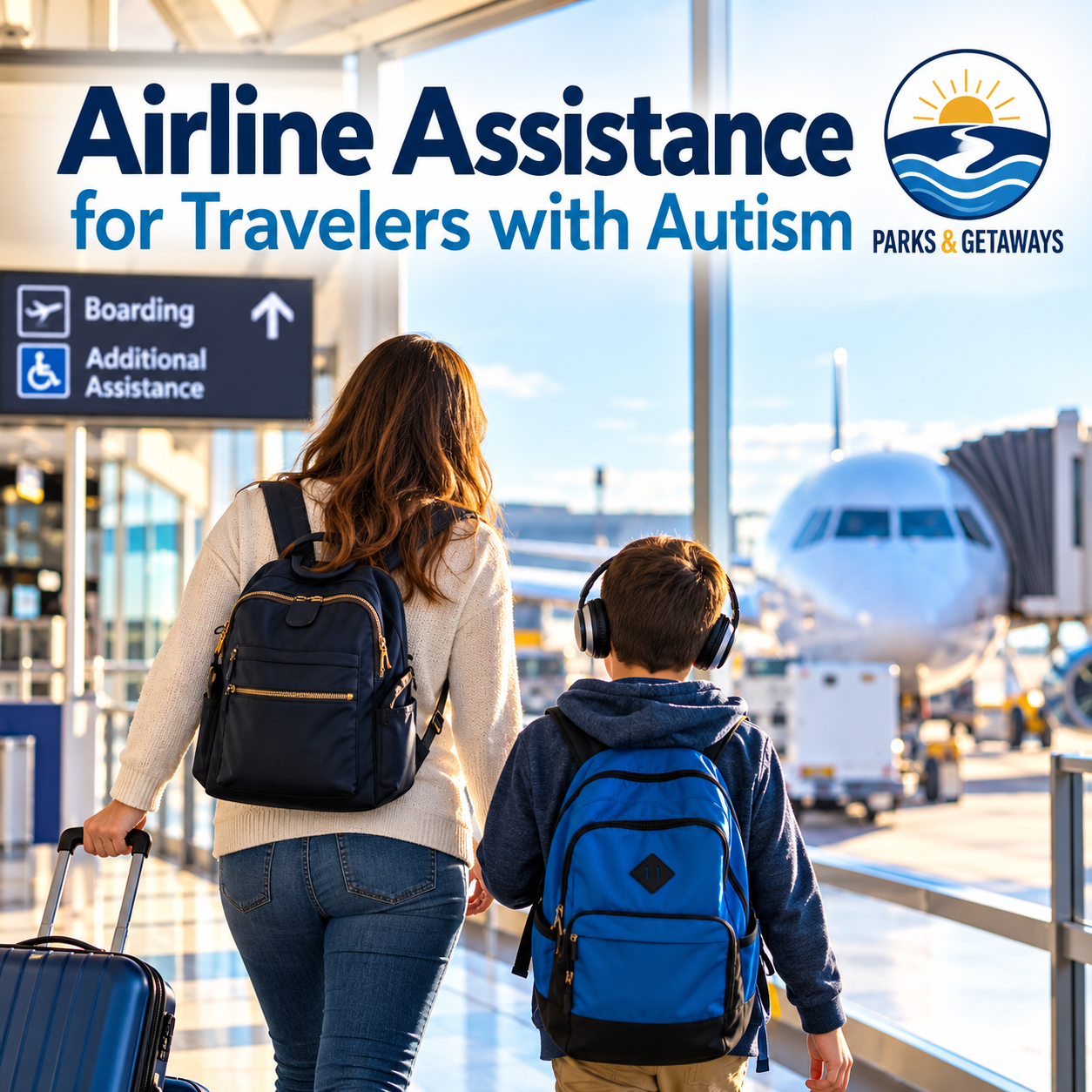
Airline Assistance for Travelers with Autism
Flying can involve a lot of unpredictability: crowded terminals, long waits, changing gates, boarding announcements, unfamiliar routines, and sensory experiences that are difficult to fully prepare for. For some individuals with Autism, those parts of air travel can be more challenging than the flight itself.
Airlines offer a variety of disability-related supports that can make the experience more manageable. Depending on the airline and the individual's needs, assistance may include help navigating the airport, preboarding, support during connections, seating accommodations, and additional assistance communicating with airline employees.
One important thing for families to understand is that there usually isn't a single service called "Autism assistance." Instead, airlines provide accommodations based on the traveler's individual disability-related needs.
When contacting an airline, explain what support would be helpful rather than simply saying that the traveler has Autism.
For example:
"My son has Autism and has difficulty navigating unfamiliar environments and crowded areas. He would benefit from assistance navigating the airport, extra time to board, and sitting next to his parent."
The more specific you can be, the easier it is for the airline to determine what assistance is available.
Your Rights When Flying in the United States
Before looking at individual airlines, it helps to understand that many accessibility services are not simply airline perks.
The Air Carrier Access Act (ACAA) prohibits discrimination against passengers with disabilities. The U.S. Department of Transportation's disability regulations apply to U.S. airlines and to flights to or from the United States operated by foreign airlines.
Depending on the traveler's disability-related needs, protections can include:
Assistance navigating the airport
Assistance boarding and deplaning
Assistance making flight connections
Preboarding when additional time or assistance is needed
Certain disability-related seating accommodations
Assistance stowing and retrieving carry-on items and assistive devices
Access to a trained Complaint Resolution Official if an accessibility problem occurs
Passengers with disabilities who identify themselves at the gate as needing additional time or assistance to board, be seated, or stow accessibility equipment must generally be given an opportunity to preboard.
Airlines are also required to provide certain seating accommodations when the passenger has a qualifying disability-related seating need. However, this does not automatically mean every traveler with Autism is entitled to any seat they choose or to additional seats at no charge. Seating accommodations depend on the individual's disability-related need and applicable regulations.
Whenever possible, contact the airline before your trip and document the assistance you are requesting.
JetBlue
JetBlue Accessibility Guidelines
JetBlue recognizes physical, cognitive, intellectual, and developmental disabilities within its accessibility guidelines and provides accommodations consistent with federal disability regulations.
Preboarding
JetBlue specifically places customers with disabilities in its preboarding group, before its numbered boarding groups.
For some travelers with Autism, preboarding can be very helpful. It can provide time to:
Find the assigned seat before the aisle becomes crowded
Put away bags and sensory items
Become familiar with the seat and surroundings
Set up a tablet, headphones, communication device, or other supports
Settle before the noise and activity associated with general boarding
Preboarding isn't necessarily the right choice for everyone. Someone who has difficulty remaining seated may prefer to spend as little time on the aircraft as possible and board later instead.
Before You Fly: If your traveler needs disability-related assistance, contact JetBlue before departure and make the request part of your travel plan. Then confirm the request with the JetBlue crewmember when you arrive at the airport.
Delta Air Lines
Delta Cognitive & Invisible Disability Assistance
Delta has one of the more detailed airline webpages specifically addressing cognitive and invisible disabilities.
Delta says assistance can include help:
Communicating with airline employees
Navigating the airport from check-in through arrival
Boarding the aircraft
Deplaning
Making connecting flights
Meet & Assist
Travelers can request Delta's "Meet & Assist at Airport" service through the Accessibility Service Request section in My Trips. Travelers can also contact Delta's Disability Line before traveling.
This may be particularly useful for an individual with Autism who can walk independently but needs assistance navigating an unfamiliar airport.
Remember that airport navigation assistance and wheelchair assistance are not the same thing. A person doesn't need a mobility disability simply because they need guidance through an airport.
Preboarding
Delta instructs travelers who need additional time to board to speak with the gate agent.
Multi-Sensory Rooms
Delta also identifies multi-sensory rooms at some of its major airports, including Atlanta (ATL), Detroit (DTW), and New York LaGuardia (LGA). These can provide a quieter place away from the main terminal environment. Availability and access procedures can change, so verify the resource before traveling.
Airport Rehearsals
Delta also points families toward Wings for All, which provides airport rehearsal experiences for individuals with intellectual and developmental disabilities and their families. Participants can practice portions of the airport experience such as checking in, going through security, waiting at the gate, and boarding an aircraft without taking a flight.
American Airlines
American Airlines Special Assistance
American Airlines specifically provides individual assistance for passengers with cognitive or developmental disabilities.
American says it can help these travelers with:
Boarding
Deplaning
Making flight connections
Special assistance can be requested during booking or added to an existing reservation through the Special Services section of the trip.
Special Assistance Coordinators
American also has Special Assistance Coordinators who can help arrange disability-related services before a trip. If special assistance is requested during booking, a coordinator may contact the traveler before departure to make sure necessary arrangements have been completed.
This is a good opportunity to explain the person's needs in concrete terms.
Instead of:
"My daughter has Autism."
Consider:
"My daughter has Autism. She can walk independently but has difficulty navigating unfamiliar environments and processing verbal directions. She needs to remain with me and may need extra time during boarding."
That gives the airline much more useful information.
When a Travel Companion May Be Needed
American notes that a traveler requiring constant care or someone who cannot follow required safety instructions may need to travel with a safety assistant. Needing Autism-related assistance does not by itself mean someone needs a safety assistant. The determination is based on the person's functional and safety needs.
Southwest Airlines
Southwest Cognitive and Developmental Disability Accommodations
Southwest has specific guidance for customers with cognitive and developmental disabilities.
The airline says escort and navigation assistance can be provided from the airport curb to and from the gates and between gates when making a connection.
Upon request, Southwest can also:
Introduce the traveler to the flight attendant and communicate their needs
Explain whether the passenger needs to deplane or remain onboard during an intermediate stop
Assist the traveler from an arrival gate to the departure gate when connecting
Southwest does not provide continuous custodial supervision or a personal attendant who remains with the traveler. A person who requires continuous personal assistance should travel with an appropriate companion.
Travelers can also notify Southwest in advance that disability-related assistance will be needed by managing their reservation online.
Alaska Airlines
Alaska Airlines Accessible Travel Information
Alaska Airlines has put particular emphasis on resources for travelers with cognitive and developmental disabilities.
Fly for All App
One of Alaska's most interesting resources is Fly for All, a free mobile app developed for people with cognitive and developmental disabilities, including Autism, as well as first-time flyers and unaccompanied minors.
The app walks travelers through the different steps involved in preparing for and taking a flight.
For families already using a social story or visual schedule, an airport-specific tool like this may be another useful preparation resource.
Disability Practice Flights
Alaska has also participated in disability practice flights.
These events allow individuals with disabilities to practice much of the travel process in a lower-pressure situation, including entering the airport, navigating security, waiting at the gate, boarding an aircraft, and in some events experiencing the aircraft taxiing without taking an actual trip.
Alaska also maintains a Disability Office focused on disability-related matters and accessibility within the airline.
Requesting Assistance
Many Alaska accessible services can be requested when booking or managing a reservation. The airline also has a dedicated Accessible Services line. Alaska recommends identifying your needs at each point of contact during the trip.
United Airlines
United Airlines Accessible Travel Information
United provides disability accommodations under the Air Carrier Access Act and has resources for travelers with cognitive and invisible disabilities.
The U.S. Department of Transportation's current seating-accommodation information lists United among the carriers providing disability-related seating accommodations through its approved seating-assignment method.
For an individual with Autism, contact United before the trip and describe the specific assistance required—for example, airport navigation, extra time during boarding, communication assistance, or a disability-related seating need.
As with other airlines, confirm the assistance again when checking in and when you arrive at the gate.
Frontier Airlines
Frontier Airlines Special Services
Frontier specifically addresses passengers with cognitive and developmental disabilities.
Frontier asks passengers, or someone acting on their behalf, to identify themselves and explain what assistance is needed at the different stages of travel. The airline can provide assistance between the airport ticket counter and the gate and between gates for connecting flights. Frontier makes an important distinction that families should understand: airline assistance is not the same as continuous supervision. Although Frontier provides disability assistance, it does not provide an employee or attendant who remains with the passenger continuously. This distinction is important when deciding whether an individual with Autism can travel independently.
Hawaiian Airlines
Hawaiian Airlines Accessible Travel Information
Hawaiian Airlines provides assistance for qualified passengers with disabilities that can include navigating between the terminal entrance and gate, boarding and deplaning, making connections, transportation between gates, and assistance with certain onboard tasks. If traveling to Hawaii, contact the airline before the trip to discuss the traveler's individual needs and confirm what assistance will be available at both the departure and arrival airports.
What Should You Ask the Airline For?
You don't need to know the airline's terminology before calling.
Start by thinking about where the traveler needs support.
For example, an individual with Autism might need:
Airport navigation:
"He can walk independently, but he needs assistance navigating from check-in to the gate."
Preboarding:
"She needs additional time to board and become familiar with the aircraft before general boarding begins."
Communication:
"He may need additional processing time when employees give him verbal directions. Please use short, clear instructions and allow him time to respond."
Connections:
"She needs assistance navigating from the arrival gate to her connecting gate."
Seating:
"Because of his disability, he needs to remain seated next to the parent who assists him during the flight. What disability-related seating accommodation is available?"
This type of information is usually much more useful than simply giving the airline a diagnosis.
Preboarding: Helpful for Some, Not Everyone
Preboarding is one of the most commonly used accommodations for travelers with Autism, but families should think about whether it actually helps their traveler. Preboarding may help someone who needs time to explore the seat, organize belongings, become comfortable with the aircraft, put on headphones, set up a communication device, or settle before the cabin becomes crowded. Boarding later may work better for someone who struggles with waiting or has difficulty remaining seated for long periods.
There isn't one correct approach. Choose the option that works for your traveler.
Airline Assistance Is Not the Same as TSA Cares
This distinction is important. The airline is responsible for airline-related accessibility assistance such as check-in, airport navigation, boarding, connections, deplaning, and certain seating accommodations. TSA manages the security screening checkpoint. If your traveler would benefit from assistance during security screening, look into TSA Cares separately. Families can use both. For example, you might arrange TSA Cares for assistance through security and request airline assistance for navigating to the gate and preboarding the aircraft. Learn more about TSA cares here.
Don't Forget the Return Flight
One of the easiest things to overlook is that assistance may need to be confirmed for every segment of the trip.
If you have a round-trip flight with connections, that could mean assistance at:
Home airport → Connection → Destination → Return airport → Connection → Home airport.
Before traveling, look at the entire itinerary and determine where assistance might be needed.
Confirm Everything at the Airport
Even when assistance has been added to a reservation, don't assume every employee you encounter will automatically know what the traveler needs.
When you arrive:
Confirm assistance at check-in.
Confirm it again with the gate agent.
If you have a connection, confirm what will happen after landing.
Before the return trip, confirm the arrangements again.
Keep your airline's accessibility information and reservation details easily accessible on your phone.
If You Have a Problem: Ask for the CRO
There is another resource families should know about: the Complaint Resolution Official, or CRO. Airlines are required to make a specially trained CRO available to address disability-related problems. The CRO is knowledgeable about the airline's responsibilities under federal disability regulations. If you encounter an accessibility problem that airline staff cannot resolve, you can say: "I would like to speak with the Complaint Resolution Official regarding a disability accommodation." Knowing this before you travel can be extremely helpful.
Plan Around the Individual
Two people with Autism may need completely different support when flying. One traveler may need preboarding and a quiet place to wait but navigate the airport independently. Another may need assistance from check-in to the gate, support during a connection, communication accommodations, and a parent seated directly beside them. Another may prefer minimal interaction with airline employees and board as late as possible. The goal isn't to request every accommodation available. It is to identify the parts of air travel that may be challenging for your traveler and request support where it will actually help. Before booking, review the airline's current accessibility information. Programs and procedures can change, and assistance can also vary by airport.
A little planning and knowing what you can ask for—can make air travel much more manageable for the entire family.