Tips for Choosing the Hotel and Room
Choosing a hotel is about more than finding the best price or picking a property close to the attractions you plan to visit. When traveling with someone with Autism, the hotel itself, and the specific room you stay in, can have a significant impact on the trip.
Think about how your traveler sleeps, eats, handles noise, manages transitions, and responds to unfamiliar environments. Consider safety needs, especially if wandering or elopement is a concern. Then look at the hotel through that lens.
A hotel that works perfectly for one family may be a poor fit for another. The goal is not to find an "Autism-friendly" hotel. It is to find a hotel and room that work for your traveler's individual needs and your family's routines.
Start With Location
Location is often one of the first things families consider when choosing a hotel, but don't think only about how close you will be to your main destination. Think about your entire day. How long will it take to get back to the hotel if your traveler needs a break? Are restaurants nearby? Is there a grocery store or pharmacy within a reasonable distance? Will you need to drive every time you leave the hotel?
For some families, paying a little more to stay closer to the places they plan to visit can be worthwhile because it makes returning to the hotel for breaks much easier. This can be particularly important at destinations such as theme parks. If you know your traveler may need several hours away from the crowds and stimulation during the day, consider how realistic it will be to leave and return.
Also look at transportation. If you won't have a car, find out exactly how you will get around. A hotel may advertise transportation, but that doesn't necessarily mean it operates frequently or will work well for your traveler.
Think About How Much Space Your Family Needs
A standard hotel room usually combines sleeping and living space into one area. That works well for many families, but it can become challenging if family members have different routines. For example, if your traveler needs to go to sleep at 8:00 p.m., what happens to everyone else? Can another family member watch television? Use the bathroom? Talk? Keep a light on?
If your traveler wakes very early, will everyone else wake up too? For some families, having separate spaces is worth the additional cost. Look for suites, connecting rooms, family suites, villas, or extended-stay hotels that offer separate sleeping and living areas.
Don't assume that a room described as a "suite" automatically has a separate bedroom. Sometimes "suite" simply means a larger room. Look carefully at the floor plan and photographs, and call the hotel if you aren't sure.
Consider Your Traveler's Sleep Needs
Sleep can quickly affect an entire vacation. If your traveler already has difficulty sleeping in unfamiliar places, pay particular attention to the hotel's environment and room location. Look through reviews for comments about noise. Don't just search for reviews mentioning Autism. Other travelers can tell you a lot about whether walls are thin, hallways are noisy, music from nearby venues can be heard at night, or rooms overlook busy areas.
When requesting a room, consider asking for a quieter location away from elevators, ice machines, stairwells, housekeeping areas, pools, restaurants, and other high-traffic spaces. An end-of-hallway room may reduce the number of people walking past your door, although you will need to balance that with your traveler's other needs. If your traveler is sensitive to outside noise, consider what surrounds the hotel as well. A hotel near nightlife, a major road, an airport, or a busy entertainment area may have more nighttime noise. And don't forget familiar sleep supports. A favorite blanket, pillow, sound machine, night-light, or other familiar item can help make a new room feel more predictable.
Look Carefully at Room Location
Where your room is located within the hotel can matter almost as much as the hotel you choose. If wandering or elopement is a concern, I recommend choosing a hotel with interior hallways rather than rooms that open directly to an exterior walkway, parking lot, or pool area.
Think about the floor as well. A ground-floor room may seem convenient, but it can also mean that opening the room door provides immediate access to the outdoors. Depending on the property, a higher floor may provide an additional layer between the room and an exterior exit.
At the same time, think about how your traveler manages elevators and stairs. If elevators are difficult, requesting a room on a very high floor may create a different challenge. You are balancing safety, convenience, sensory needs, and your traveler's abilities.
Think About Balconies
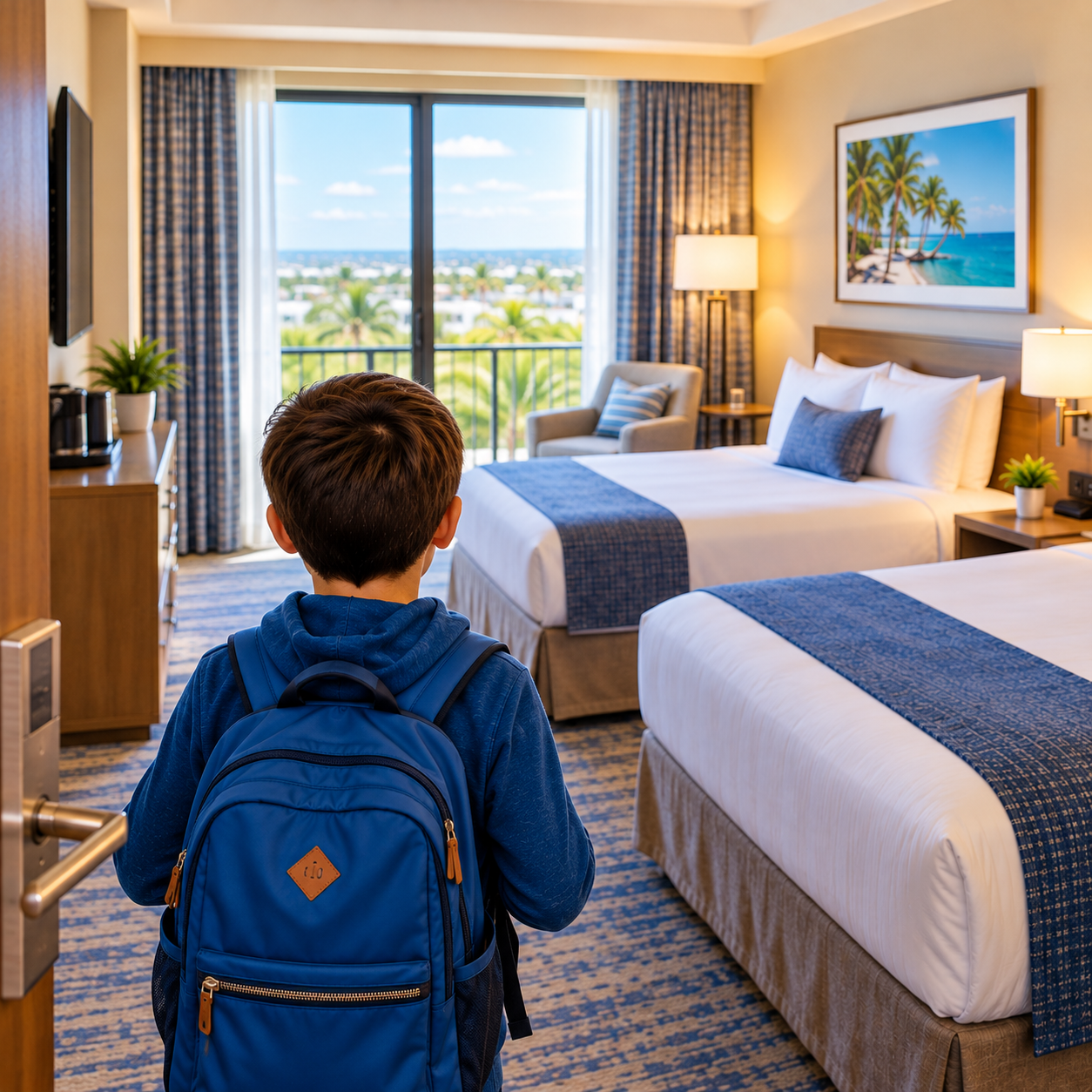
A beautiful balcony may be a selling point in a hotel advertisement. For some families, it may be something to avoid. If your traveler has wandering, climbing, impulsivity, or safety-awareness concerns, look carefully at whether rooms have balconies and how balcony doors are secured.
You may decide that a room without a balcony is the better choice. Don't assume that because a balcony door has a lock, it will be inaccessible to your traveler. Hotel door and window hardware can be very different from what you use at home. This is something worth asking about directly before booking if it is an important safety consideration for your family.
Look at the Bathroom
Hotel bathrooms don't get much attention when people book a vacation, but they can create unexpected challenges. Look at room photographs whenever possible. Does the bathroom have a bathtub or only a shower? Is it a walk-in shower? Does the shower have a handheld showerhead? Is the bathroom brightly lit? Is there a loud exhaust fan that turns on automatically with the light?
If your traveler strongly prefers a bathtub, booking a beautiful room with a walk-in shower may become a problem every night. If accessibility is needed, don't rely only on photographs or a generic "accessible room" label. Find out specifically what accessibility features are included in that particular room category.
Think About Food Before You Book
Food is another area where a little planning can prevent a lot of stress. If your traveler has a limited number of preferred foods, look at what food options will actually be available. Does the hotel have restaurants? What are their hours? Can you view the menus before your trip? Is there somewhere nearby to buy groceries or familiar foods? Then look at what is available inside the room.
A refrigerator can make a major difference if you need to store preferred foods or drinks. A microwave may be equally important. Some extended-stay properties offer kitchenettes or full kitchens. Don't assume that every room includes a refrigerator or microwave just because you see one in a photograph. Check the amenities listed for the specific room category you are booking. If refrigeration is needed for medication, contact the hotel directly about your needs rather than assuming a standard minibar or beverage cooler will be appropriate.
Consider the Hotel's Amenities
Amenities should be evaluated based on what your family will actually use. A pool may be a major benefit for a traveler who loves swimming. For another traveler, a visible pool may become a significant safety concern or make transitions harder because they want to swim every time they walk past it. The same applies to arcades, restaurants, children's areas, large lobbies, entertainment, and other hotel features.
More amenities don't automatically mean a better hotel. Sometimes a smaller, quieter hotel with fewer shared spaces will work better than a large resort with constant activity. Other families may benefit greatly from having restaurants, activities, transportation, and recreation available without leaving the property. Think about your traveler rather than the hotel's star rating or longest amenities list.
Look Beyond the Hotel's Marketing Photos
Hotel websites are designed to show properties at their best. Before booking, look beyond the professional photographs. Read recent guest reviews and pay particular attention to comments about noise, cleanliness, room size, elevators, parking, housekeeping, construction, pools, transportation, and the general atmosphere of the hotel.
Guest photographs can be especially useful. Professional photographs may use wide-angle lenses or show only one particular room. Traveler photos can give you a more realistic idea of room size, bathroom configuration, balconies, door locations, hallways, and how close different areas of the hotel actually are. You can also look at the property on a map to better understand its location and surroundings.
Think About the Hotel's Shared Spaces
The hotel room isn't the only environment your traveler will need to navigate. You may need to walk through a busy lobby several times each day. You may use crowded elevators. Breakfast areas can be noisy in the morning. Pool decks can be loud and unpredictable.
Large resorts may involve long walks just to reach your room. Think about the entire experience of moving through the hotel. If your traveler has difficulty with elevators, ask whether stairs are available and accessible to guests. If crowds are difficult, consider whether you can adjust when you use common spaces. If your traveler is prone to wandering, identify exits and other potential hazards when you arrive.
Communicate With the Hotel Before You Arrive
If you have an important room request, don't wait until check-in to explain it. Contact the hotel before your trip. Be specific about what you need rather than simply saying that someone in your family has Autism.
For example, you might request:
A quiet room away from elevators and ice machines
An interior hallway room
A room away from the pool
A room without a balcony
A particular floor
A bathtub rather than a shower
A refrigerator or microwave
Connecting rooms
A suite with a separate sleeping area
A room near or away from an elevator, depending on your needs
You can also ask about dining, sensory considerations, accessibility features, and other supports that are important to your traveler.
Guest services or the concierge may be able to answer questions before your trip that a general reservation agent cannot. Keep in mind that hotel room locations are often requests rather than guarantees. Room assignments may not be finalized until close to arrival. Make your requests early, explain which ones are most important, and confirm them again shortly before your trip.
Don't Rely on an "Autism-Friendly" Label
Some hotels and resorts offer Autism-related programs, sensory resources, staff training, or other accessibility services. Those resources can certainly be helpful. But a designation or program should not replace your own research. A hotel can offer excellent Autism-related services and still have a room configuration that doesn't work for your traveler.
Likewise, a hotel without a formal Autism program may turn out to be an excellent fit because it offers the quiet environment, room layout, food options, safety features, and location your family needs. Look at the actual features of the property and decide whether they match your traveler's needs.
Make a Short List of Your Non-Negotiables
It is easy to get overwhelmed comparing dozens of hotels. Before you start searching, identify the things that matter most to your family. Maybe you need a separate bedroom because sleep is your biggest concern. Perhaps you need an interior hallway and no balcony because wandering is a concern. You may need a refrigerator for preferred foods or a bathtub because your traveler will not use a shower. Those are your non-negotiables.
Then identify the things that would be nice to have but aren't essential. This makes it much easier to compare hotels without getting distracted by amenities that look appealing but won't actually make your trip easier.
Choose the Hotel That Works for Your Traveler
The most expensive hotel isn't necessarily the best hotel. The property with the most amenities isn't necessarily the best hotel either. The right hotel is the one that fits the way your family actually travels. Think about location, room layout, sleep, noise, food, bathrooms, transportation, safety, and the amount of stimulation throughout the property. Look carefully at photographs and reviews. Ask questions before you book. Make important room requests early. Most importantly, don't be afraid to prioritize something that may seem insignificant to another traveler.
If having a bathtub prevents a difficult bedtime every night, it matters. If a separate bedroom means everyone sleeps, it matters. If an interior hallway makes you more comfortable about wandering risk, it matters. If being ten minutes closer to your destination makes it possible to return to the hotel for a midday break, it matters.
You aren't looking for the hotel everyone else thinks is best. You are looking for the hotel and room that will work best for your traveler and your family.