Wandering, Elopement & Autism Travel Safety
Travel brings new experiences, but it also means unfamiliar environments, changes in routine, crowded spaces, and places that may be difficult to navigate. For a person with Autism who wanders, elopes, or may become separated from their family or caregiver, these changes can create additional safety concerns. Airports, hotels, theme parks, beaches, cruise ships, vacation rentals, and busy city streets all present different risks.
Planning for wandering and elopement while traveling is not about avoiding travel. It is about anticipating what could happen, building safety skills before the trip, putting layers of protection in place, and having a clear plan if separation occurs. No single strategy can prevent every incident, so the strongest approach combines preparation, supervision, identification, technology when appropriate, and an emergency response plan.
Know the Wandering Risks
Before planning for a trip, think about what wandering or elopement looks like for your loved one. Some people may suddenly run toward something they want to see. Others may leave an overwhelming environment to escape noise, crowds, waiting, or demands. A person may wander in search of water, a favorite object, food, transportation, or another highly preferred destination.
Consider what has happened in the past. What tends to occur immediately before the person leaves? Where do they usually try to go? Are there particular triggers, times of day, transitions, or environments that increase the risk?
Then consider how those patterns could translate to your destination. A person who is strongly drawn to water may require additional safeguards at a beach resort or vacation rental with a pool. Someone who leaves when overwhelmed by crowds may need a very different plan at a theme park, airport, sporting event, or busy attraction. Understanding the reason behind wandering helps you plan supports rather than relying only on reacting after it happens.
Practice Safety Skills Before You Travel
One of the most valuable things you can do happens before the trip begins. Identify a few practical safety skills that your loved one can practice at home and in familiar community settings. The goal is not necessarily independence. The appropriate goal depends on the person's age, communication abilities, support needs, and current skills. For some people, staying within arm's reach of an adult may be appropriate. For others, the goal might be checking in regularly or knowing where to meet if separated.
Useful skills to practice can include:
Staying with an adult or caregiver. Practice walking together in parking lots, stores, community events, and other increasingly busy environments.
Stopping and returning when prompted. Practice simple safety directions such as "stop," "wait," and "come here" in safe environments.
Waiting. Airports, attractions, restaurants, transportation, and hotel check-ins all involve waiting. Practice short periods of waiting and gradually build from there.
Asking for a break. If your loved one sometimes leaves because an environment becomes overwhelming, teach a way to request a break before reaching that point. This could be spoken language, a communication device, sign, gesture, or break card.
Communicating basic information. When appropriate, practice giving a name, caregiver's name, or phone number.
Showing identification. If your loved one carries or wears identification, practice what to do with it. A person might learn to point to a bracelet, hand someone an ID card, or show information stored on a phone.
Responding to a caregiver's name or call. Practice this in increasingly distracting but controlled settings.
Visual supports, social stories, and video modeling can also help prepare someone for what these skills will look like during the trip. Practice them before you need them in a crowded airport or unfamiliar destination.
Teach What to Do if You Become Separated
"Don't talk to strangers" can become complicated when someone actually needs help. A more useful safety skill may be learning which people to approach when help is needed. Depending on the person's abilities, teach them to look for recognizable helpers such as a police officer, firefighter, security officer, airline or airport employee, theme park employee, hotel front-desk employee, lifeguard, or another uniformed staff member.
You can also teach a simple action or phrase such as, "I am lost," "I need help," or "Please call my mom." For someone who does not reliably communicate verbally, an ID bracelet, identification card, communication device, or other visual support can provide this information. Practice the skill rather than only discussing it. Role-play becoming separated and identifying an appropriate person to approach. If your loved one uses an AAC device, make sure important emergency phrases are easy to locate.
Community Helpers
Stranger awareness is important, but the concept needs nuance for a traveler with Autism. A person who has been taught never to interact with strangers may avoid exactly the people who could help during an emergency. Instead, consider teaching the difference between an unknown person and a designated helper. Use photographs or videos of police officers, firefighters, airport employees, hotel staff, lifeguards, security personnel, and other people your loved one may encounter while traveling.
At the same time, teach boundaries that are appropriate for the person's level of understanding. For example, a person might learn that they can tell a staff member their caregiver's name and phone number but should not leave the location with an unknown person unless that person is an identified responder or staff member.
Use Identification as a Layer of Protection
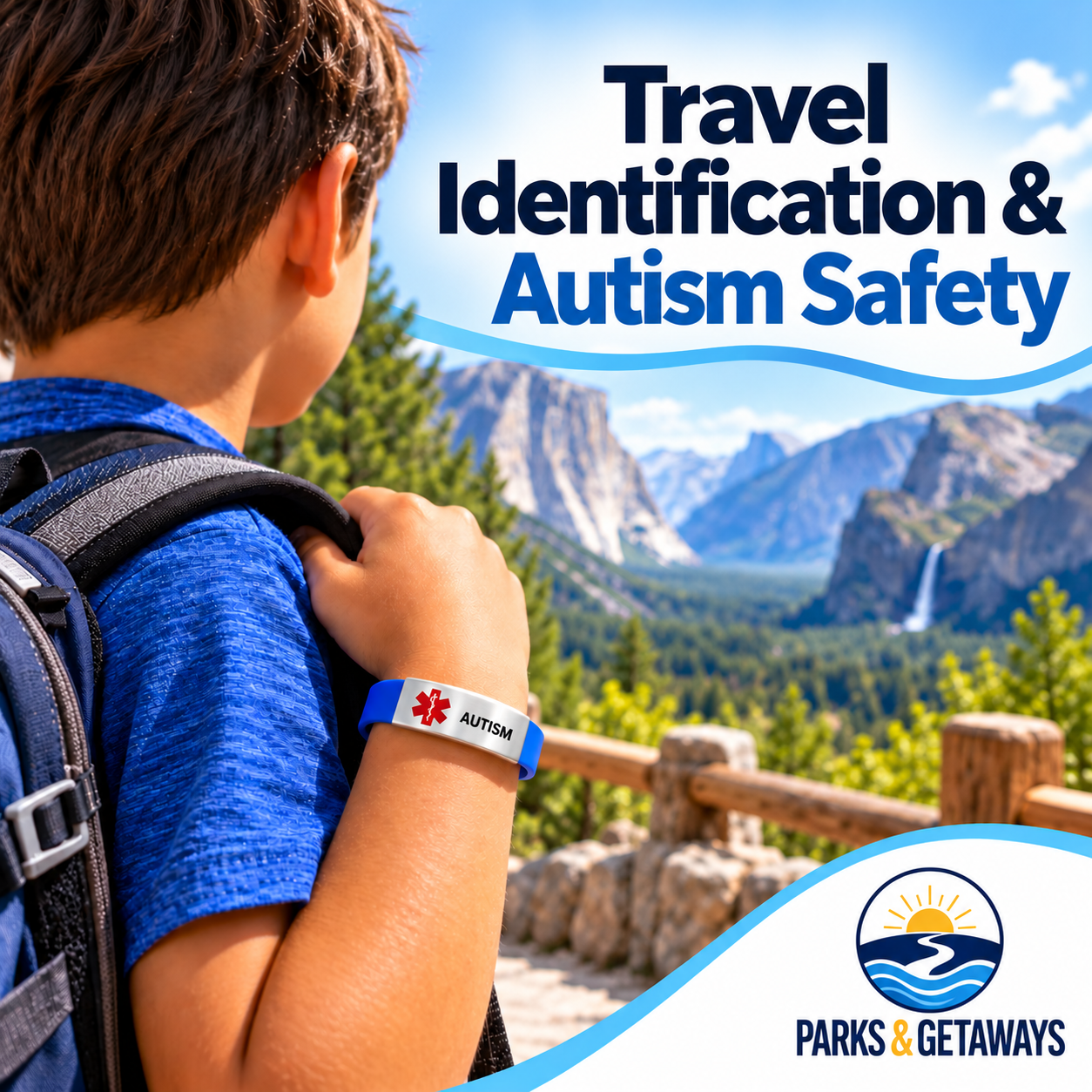
Identification can be especially important for a person who may not reliably provide their name, address, caregiver's contact information, or other critical information when frightened or overwhelmed. Options include medical ID bracelets, shoe tags, wallet cards, temporary identification bands, information stored on a phone, temporary tattoos or identification attached securely to clothing or belongings. The best option is one your loved one will tolerate and that is likely to remain with them.
Emergency identification can include the person's name, caregiver's phone number, communication information, and essential safety information. Avoid including unnecessary private information.
For more information about selecting identification and deciding what information to include, see our Medical ID & Identification for Autism Travel Safety article.
Consider GPS and Location-Tracking Technology
GPS trackers and other location devices can provide an additional layer of protection for some families. Depending on the device, a tracker may be worn on the wrist or ankle, attached to clothing, carried in a pocket, or incorporated into another item.
Before traveling, understand how your particular device works. Check its battery life, cellular or GPS requirements, coverage limitations, waterproofing, subscription requirements, and how frequently location information updates. Test the device before the trip rather than using it for the first time while traveling. Technology should be considered a backup layer rather than a replacement for supervision or an emergency plan. Devices can lose power, be removed, fail to connect, or provide delayed or imprecise location information.
Learn About Project Lifesaver
Project Lifesaver International is another resource families may want to investigate. Project Lifesaver is a community-based public safety program that helps locate individuals who are at risk of wandering, including people with Autism, using wearable radio-frequency technology and specially trained search teams. The program is offered through participating local law enforcement and public safety agencies, so families should check availability and enrollment requirements in their community. Families should contact their local participating agency to determine eligibility and understand how the program works.
It is also important to understand what happens when you travel outside your home community. Ask your local Project Lifesaver agency how travel should be handled and whether the program can assist when you are away from the jurisdiction where your loved one is enrolled.
Plan for High-Risk Locations
Not every part of a trip carries the same level of risk. Identify your highest-risk locations before you leave. At a hotel, that could mean the room door, elevators, stairwells, parking areas, balconies, or the pool. At a vacation rental, it may include exterior doors, unfamiliar locks, nearby roads, woods, or bodies of water. At an airport, it could be security lines, crowded terminals, trains between terminals, bathrooms, or boarding areas. At a theme park or attraction, crowds and multiple pathways can make someone difficult to locate quickly.
Water deserves particular attention. If your loved one is drawn to water, identify pools, beaches, lakes, ponds, fountains, canals, rivers, and other nearby water before arriving whenever possible. Your response plan should prioritize checking water immediately when it is a known risk.
Reduce the Need to Elope
Some wandering cannot be predicted, but sometimes there are recognizable triggers. Travel can amplify them. Long waits, sensory overload, hunger, fatigue, unexpected schedule changes, unfamiliar environments, communication difficulties, and losing access to a preferred activity can all contribute to someone leaving an area.
Build breaks into your plans. Bring communication supports, preferred items, snacks, headphones, sensory tools, or other supports that work for your loved one. Use visual schedules when helpful and prepare for transitions before they occur. Most importantly, give the person a safe way to communicate "I need a break," "I need to leave," "too loud," "all done," or another message that serves the same purpose. Being able to communicate the need to leave is very different from having to elope in order to get away.
Have a Supervision Plan in Crowded Places
Crowded attractions require more than simply deciding to "keep an eye on everyone." Decide in advance which adult is responsible for supervision, particularly when several adults are traveling together. Use clear handoffs. Instead of assuming another adult is watching, verbally transfer responsibility: "You have Sam while I check us in."
Be especially careful during transitions. Entering or leaving an attraction, getting on transportation, checking into a hotel, collecting luggage, ordering food, and managing other children are moments when adults naturally become distracted. For someone at higher risk of elopement, these transition points may require increased supervision.
Create a Current Photo Before Each Outing
Take a quick full-body photograph of your loved one before leaving the hotel or vacation rental each day. The photo provides an immediate record of exactly what the person is wearing. If separation occurs, you will not have to remember whether today's shirt was blue or green while under significant stress. You can immediately show or send responders a current photograph. For people with a significant history of wandering, consider keeping an easily accessible emergency information sheet on your phone as well.
Have a Missing-Person Emergency Plan
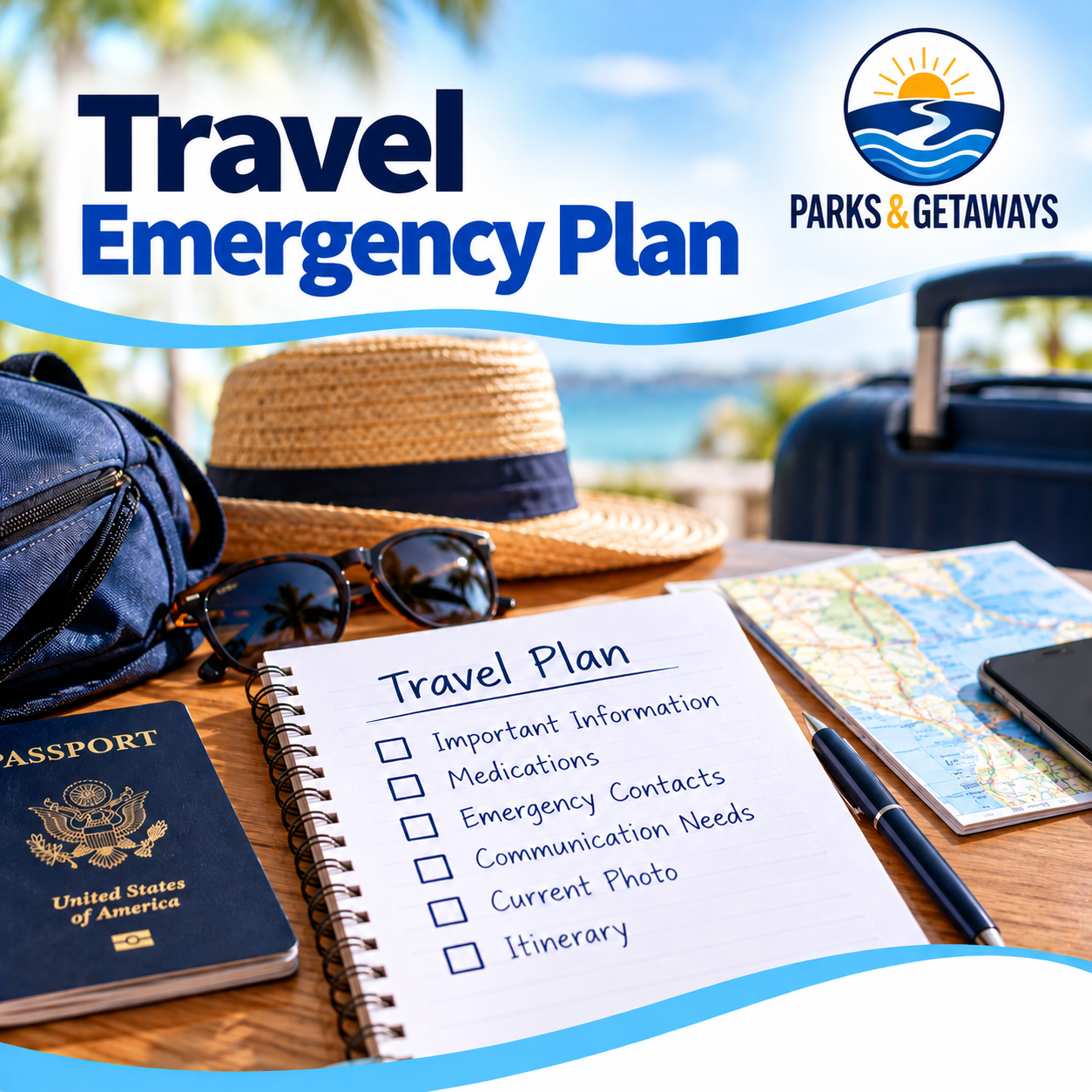
Do not wait until someone is missing to decide what everyone should do. Your travel emergency plan should establish who calls emergency services, who searches immediate areas, who checks water and other high-risk locations, who remains at the last known location, and who supervises other children or family members.
Before visiting a major attraction, hotel, cruise ship, or resort, consider finding out how the property handles a missing or separated guest. Knowing where to find security and how to contact staff can save valuable time. If your loved one becomes missing, communicate clearly that the person has Autism and is at risk along with any specific risks such as attraction to water, limited communication, lack of danger awareness, or a tendency to hide or continue moving. Your emergency information should also include likely destinations and anything responders should know about how to approach, communicate with, or safely assist your loved one.
For a more detailed plan, see our Creating an Autism Travel Emergency Plan article.
Build Layers of Protection
Wandering and elopement safety works best when families do not depend on one strategy. A GPS tracker can fail. An ID bracelet cannot prevent someone from leaving. A practiced safety skill may be difficult to use when a person is frightened or overwhelmed.
Instead, build several layers around your loved one: appropriate supervision, practiced safety and communication skills, identification, environmental safeguards, location technology when appropriate, informed travel companions, and a written emergency plan.
The plan should also change with the trip. The safeguards needed for a hotel in a city may be different from those needed at a beach house, theme park, campground, cruise ship, or national park.
Traveling with a person who has a history of wandering or elopement requires additional preparation, but that preparation can become a routine part of travel planning. Know the risks at your destination, practice the skills your loved one can realistically use, put multiple protections in place, and know exactly what you will do if separation occurs.
Download the Free 5-Minute Safety Check
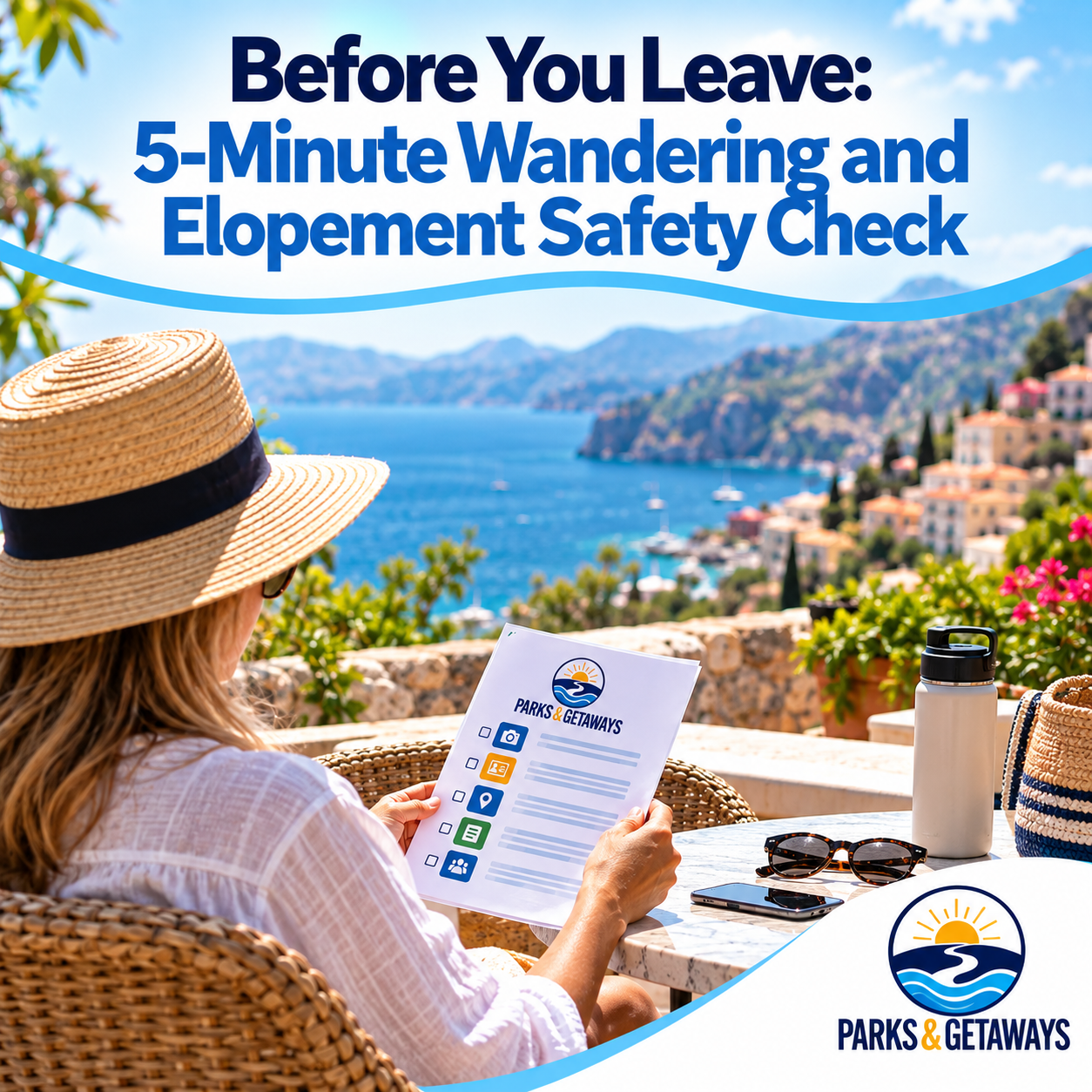
Before heading out for the day, take five minutes to review your wandering and elopement safety plan. Our free Before You Leave: 5-Minute Wandering and Elopement Safety Check gives families a simple checklist to review identification, supervision, communication, tracking devices, high-risk locations, water risks, and what to do if separation occurs.
Download or print the checklist and keep it with your travel documents so you can use it before heading to an airport, theme park, attraction, beach, or other destination.